
The visit of Park Geun-Hye to India, though a symbolic one, will certainly give a further impetus to the strategic partnership between the two countries says Rup Narayan Das.

'We use the word "historic" perhaps too much, but the prime minister's visit certainly was historic in so many ways.'

PM Modi seems to be gradually ending India's strategic ambiguity

Offering lucrative incentives, Telecom Minister Ravi Shankar Prasad on Sunday invited US technology companies to start manufacturing in India, for meeting domestic needs and exports, under the 'Make In India' initiative.

'Modi's investment in the relationship with Washington is the biggest deliverable of this visit. He means business and that's fantastic!'

'The Chinese made their point repeatedly after August 5. They backed Pakistan more overtly than in the past.' 'Kashmir is not completely off their radar. But in order to keep the atmosphere surrounding the Chennai meeting, they did not discuss Kashmir.'

Both India and South Korea will use President Park Geun-hye's visit to unveil a comprehensive programme for mutual benefit and impacting on regional security environment, says Srikanth Kondapalli.

Israeli President Reuven Rivlin arrived on Monday on an eight-day visit to India, the first by any Israeli President in nearly two decades.

Possible US envoy says India must get assurance against China.
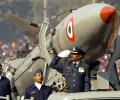
While we have to hiss loudly and do the lunging bit to keep our foes on their toes, that's only a tactical matter. What is the strategic goal? What is the end game? In my opinion, there is only one possible end game: the unwinding of Pakistan into several pieces: Balochistan, Sind, Balawaristan (Gilgit, Baltistan, the rest of PoK), the Pashtun area Khyber Pakhtunwa which will merge with Afghanistan, and the rump Punjab, says Rajeev Srinivasan.

As the pandemic unfolded, the India-China relationship has come under severe stress. To restore normalcy, agreements between the two countries must be respected scrupulously in their entirety. Where the Line of Actual Control is concerned, any attempt to unilaterally change the status quo is unacceptable, declares External Affairs Minister Dr Subrahmanyam Jaishankar.

'India is no longer the India of the '70s and the '80s.' 'It's a large country with the fastest growing economy.' 'In working with India, you just can't go and humiliate the nation publicly.' USIBC President Mukesh Aghi tells Aziz Haniffa/Rediff.com about how he advises American companies to do business with India, what he thinks of Modi's government and the way forward for the India-US relationship.

Investment in market leaders with a safety-first approach could yield reasonable returns across sectors.
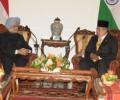
The two countries have decided to expedite trade related issues and signed six pacts to take forward their strategic partnership. Rediff.com's Sheela Bhatt, who is travelling with the prime minister on his visit to Indonesia, reports from Jakarta.

Prime Minister Narendra Modi's three-day visit to Britain has seen India and the UK agreeing on Rs 90,000 crore deals.

His view will be shaped by his perception of US world interests and India's economic performance relative to China.
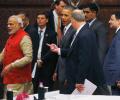
PM promised a tax regime that is predictable and competitive
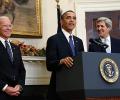
'The threat that India faces and the threat the United States faces is not just to the homeland, but to our people and to our institutions wherever they may be.' In an exclusive conversation with Aziz Haniffa/Rediff.com, US Assistant Secretary of State Nisha Desai Biswal outlines the importance of Prime Minister Modi's visit for America.

'The debate is not whether the Indian defence apparatus is in a state of disrepair, but whether it is capable of securing the defence of the country if any envisaged threat becomes real.'

'The US wants Modi to succeed because we want India to succeed. For our part, when India thinks of its partners in the world, we want it to think of the US first. That means positioning our country as the preferred provider of the key inputs that can help to propel India's rise.' 'The meeting between Modi and Obama is, and must be, an opportunity for true strategic dialogue -- not a scripted exchange of talking points, but an open discussion of the big questions. What kind of world do we want to live in? What are our true priorities? And most importantly, why does this partnership still matter?'
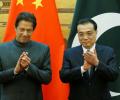
In recent years, China has refrained from taking a public stance on the India-Pakistan ties, expressing hope for resolution of the disputes through dialogue.
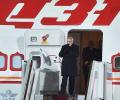
During his two day visit, Modi is expected to seal a raft of major deals in defence, nuclear energy and hydrocarbons sectors to further cement their 'special and privileged strategic ties'.

In the run up to three years of the National Democratic Alliance government, Minister of State for Commerce and Industry (Independent Charge) Nirmala Sitharaman says it is time to consolidate some of the major initiatives as well as take new steps.
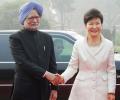
South Korean President Park Geun-hye's visit to India will enhance economic and military ties between the two countries and give the relationship a strategic dimension, says Jiye Kim.

With the United States delivering an increasing share of India's arms imports, New Delhi must work with it to retain control of our regional waters

'Ensuring through diplomatic means and in conjunction with strategic partners that India will not be required to fight a simultaneous two-front war with China and Pakistan.' Brigadier Gurmeet Kanwal (retd) lists what India must have in its national security strategy.
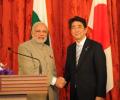
India and Japan are natural partners at sea, and Narendra Modi's recent visit underlined the need to keep the association going
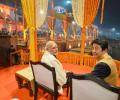
'Modi and Abe are working seriously for India-Japan bonhomie to grow stronger.' 'It is a win-win situation for both countries and the future look promising,' says Rajaram Panda, the Indian Council for Cultural Relations India Chair Visiting Professor at Reitaku University, Japan.

Indians want change and progress. They should be willing to accept tough decisions, says Sanjeev Nayyar.
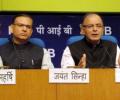
All credit to the finance minister for walking the fiscal and expectation tightrope extremely well in his budget speech, says Ganesh Natarajan.

Information technology, not manufacturing or infrastructure, should be the focus of the government while implementing initiatives such as Make in India and Start Up India.
'The domestic scenario is much better than earlier, demonstrated in the March quarter earnings.'

In good times, analysts justify valuations giving interesting investment rationale.

'While economic ties are making incremental progress, it is in the security and strategic domains that the India-Japan synergy is more compelling,' says Dr Rajaram Panda.

'Despite frequent high-level interactions there has been little traction on substantive issues between India and France,' says Mohan Guruswamy.

'The Senators were playing safe, not angering either the pro-India lobby or the pro-Pakistan lobby, but perhaps more importantly, the military-industrial complex -- the most powerful lobby of all -- which the majority of Senators are beholden to in terms of largesse to their campaign coffers.'
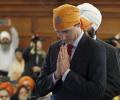
'The India-Canada relationship has suffered benign neglect. Its full potential has not yet been realised,' says Rup Narayan Das.

"Just a handful of Indian youth have joined the ISIS. Some have also returned after being persuaded by their families," asserted the home minister.
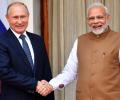
'Washington senses that the anchor sheet of India's strategic autonomy lies in its longstanding partnership with Russia, which remains firm and immutable despite the changes in world politics in the post-Cold War era,' notes Ambassador M K Bhadrakumar.<

Here's the full text of President Ram Nath Kovind's customary address to the joining sitting of Parliament on the first day of the budget session.
